
EBRD
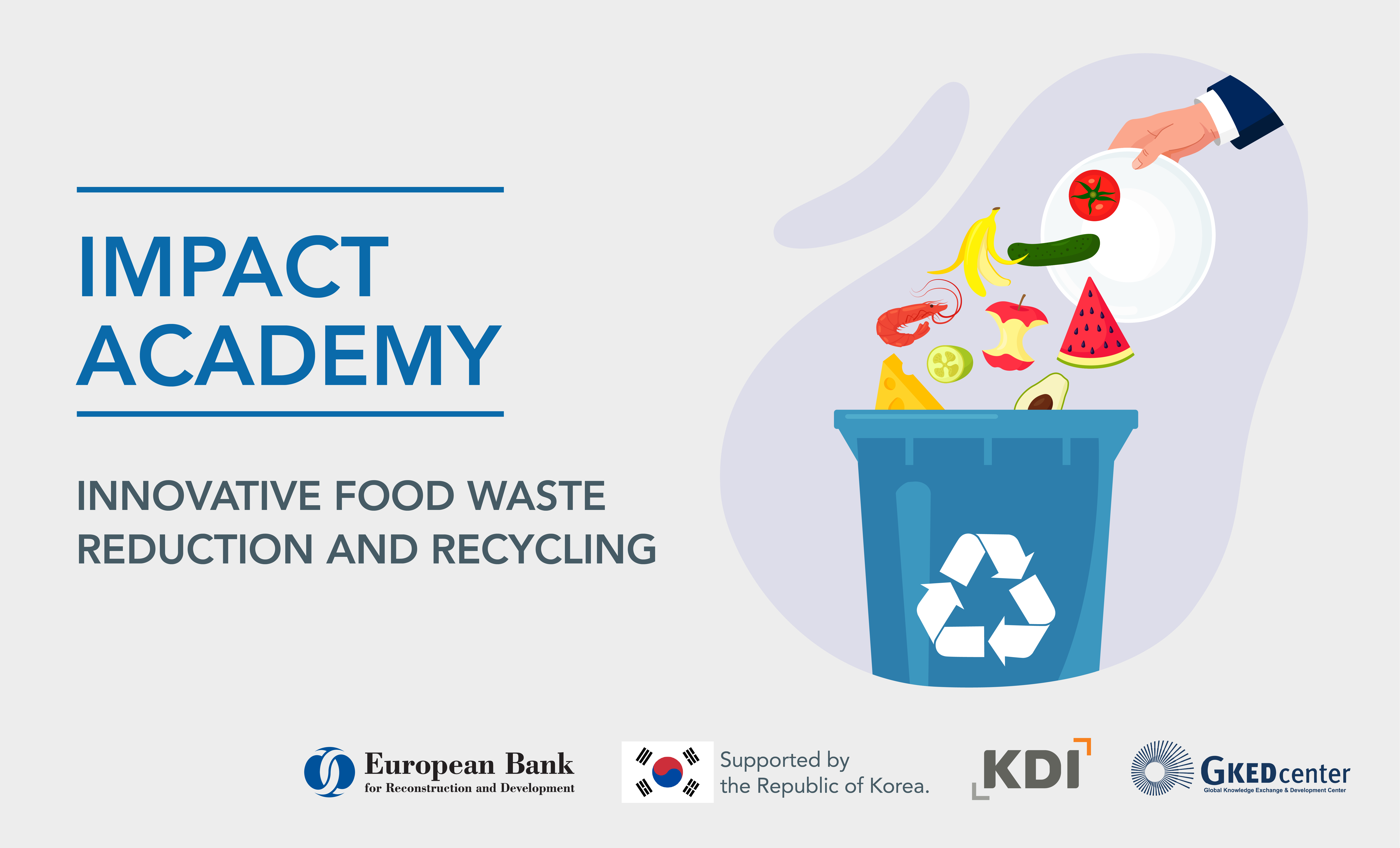
Innovative Food Waste Reduction and Recycling
This module strengthens policy capacity in food loss and waste (FLW) reduction and recycling across EBRD countries of operations.
About the Module
This module is designed to enhance policy knowledge and expertise in food loss and waste (FLW) reduction and recycling among stakeholders in EBRD countries of operations, drawing on the Republic of Korea’s best practices. It aims to support the development and implementation of policy actions that promote a sustainable food value chain while addressing critical challenges such as climate change and food security.
Effective FLW reduction requires robust governance, clearly defined targets, data-driven collaboration, infrastructure investment, and comprehensive stakeholder engagement. Emerging technologies, particularly ICT, blockchain, and AI, are pivotal in transforming agrifood systems by enhancing traceability, efficiency, and resource optimisation.
Given that persistent knowledge and capacity gaps among public institutions and businesses continue to hinder investment in FLW reduction, this blended learning programme is designed to address these challenges by providing stakeholders with practical insights, policy frameworks, and innovative solutions to drive the transition towards a more sustainable food system.
To successfully complete the module and receive a personalized certificate, you must pass a knowledge test after each session and final assessment; as well as complete the learning effectiveness (application) questionnaire, a link to which you will receive by email two months after completing the module.
This online training Module is web-based. Therefore, no additional software is required. Please be aware that "EBRD Impact Academy" does not provide tutor support. Learning content is current at the time of its public launch (April 2026).
If you have any questions about this module, you can contact us at impactacademy@ebrd.com.
Learning Objectives
The Module “Innovative Food Waste Reduction and Recycling” has five self-paced sessions. The goal is to:
-
- Understand the key concepts of food loss and waste (FLW) and the circular economy;
- Apply digital technologies and system-level approaches to design solutions for reducing and recycling FLW; and
- Identify policy actions and investment opportunities to support the transition towards a sustainable, data-driven, and circular food system.
Length: Approximately 3-4 weeks
Effort: 1-2 hours per week
Module duration: Approximate average of 7 hours, including video, assessments, and knowledge check.
Language: British English
List of Lecturers
Session One: Food Loss and Waste: Why It Matters?
Ju Munsol
Senior Research Fellow, Korea Environment Institute
Session Two: Preventing Food Loss Across the Supply Chain: From Production to Processing and Packaging
Kim Yong Jin
Professor, Inha University
Min Alexander Myoung joon
CEO, RE:harvest
Session Three: Reducing Food Waste at the Consumer Level
Hong Yeona
Assistant Professor, Kongju National University
Session Four: Strategies for Sustainable Food Waste Treatment
Phae Chae-gun
Emeritus Chair Professor, Seoul National University of Technology
Kim Da eun
Deputy Director, Sewerage Division, Ministry of Climate, Energy and Environment, Republic of Korea
Session Five: Overcoming Barriers to a Zero-Waste Transition
Ju Munsol
Senior Research Fellow, Korea Environment Institute
Annex. The Theory of Change of Food Loss and Waste
Cherry Khalil
Former Economist, EBRD
The EBRD Impact Academy is supported by the "TaiwanBusiness-EBRD Technical Cooperation Fund". This specific learning module is supported by the Republic of Korea.
__________________________________________________________
Please note: This video is based on research materials prepared independently by the author and is provided for educational and academic purposes only. All content including corporate case studies are referenced for informational and educational purpose and do not constitute any form of commercial endorsement or promotion.
Furthermore, the content included in these learning materials does not necessarily represent the official position of the European Bank for Reconstruction and Development, nor that of other institutions and organisations with which non-EBRD lecturers are associated.
Hyperlinks to non-EBRD websites and/or other resources do not imply any official endorsement of or responsibility for the opinions, ideas, data or products presented at these locations, or guarantee the validity of the information provided. The sole purpose of links to non-EBRD sites is to indicate further information available on related topics.
All rights reserved. No part of this platform may be reproduced or transmitted in any form or by any means, including photocopying and recording, without the written permission of the copyright holder. Such written permission must also be obtained before any part of this publication is stored in a retrieval system of any nature.
© European Bank for Reconstruction and Development
Five Bank Street
London E14 4BG
United Kingdom