
EBRD
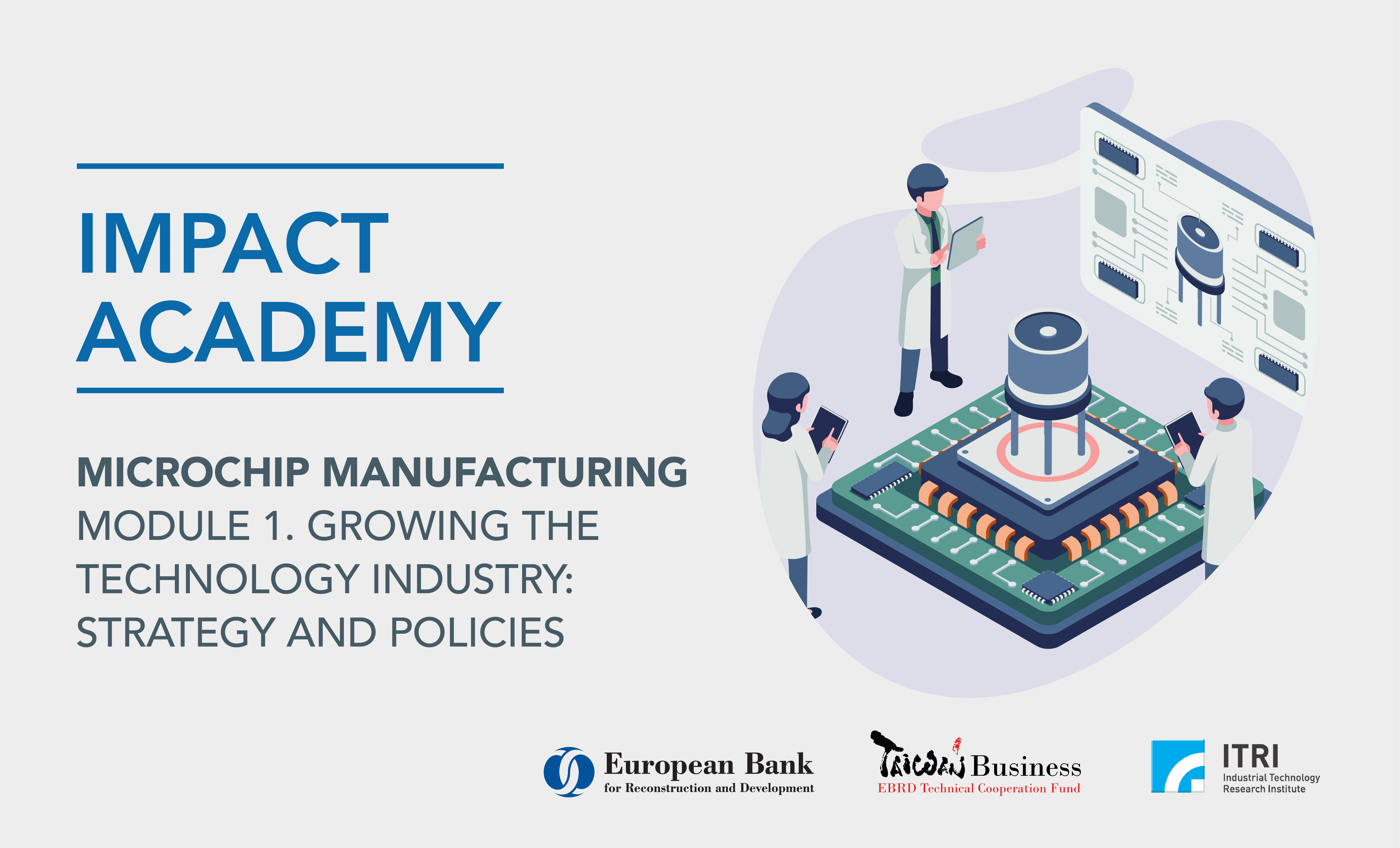
Microchip Manufacturing, Module 1. Growing the Technology Industry: Strategy and Policies
Explore semiconductor growth, science parks, and policies addressing industrial and geopolitical challenges.
About the Module
This module will begin with a brief introduction to the history of the Taiwanese high-tech industry development. It will cover government-led industrial development policies and the establishment of research institutions (such as ITRI) that spearheaded the early stages of Taiwanese semiconductor industry development.
Next, it will describe the establishment of science parks and their internal innovation systems, which have become defining features of the Taiwanese high-tech industry.
Finally, we will discuss how the Taiwanese government is addressing current industrial development and geopolitical issues by proposing sustainable and forward-looking policies to tackle these challenges.
To successfully complete the module and receive a personalized certificate, you must pass a knowledge test after each session and final assessment; as well as complete the learning effectiveness (application) questionnaire, a link to which you will receive by email two months after completing the module.
This online training Module is web-based. Therefore, no additional software is required. Please be aware that "EBRD Impact Academy" does not provide tutor support. Learning content is current at the time of its public launch (October2026).
If you have any questions about this module, you can contact us at impactacademy@ebrd.com.
Learning Objectives
By completing this module, you will gain an understanding of the development trajectory of the Taiwanese high-tech industry. This knowledge will help you comprehend how government policies, research institutions, science parks, and companies form an innovation system that has driven Taiwanese economic growth. Additionally, you will learn how this system continues to advance amidst rapidly changing geopolitical circumstances.
Total Time to Complete the Module:
Effort: 2 hours per week
Total time: 6 hours
Module Structure
This Module consists of the following seven sessions:
-
- Session 1: Role of Technology Industry in Economic Development
- Session 2: A National Technology Industry Eco-System
- Session 3: Technological Building Blocks: GAA & Advanced Packaging Patents
- Session 4: Innovation System Building Blocks: the Case of Hsinchu Science Park (HSP)
- Session 5: The TSMC Model: Vertical Disintegration and Virtual Integration
- Session 6: Hardware Services Model: Global Production Networks (GPNs) & Global Innovation Networks (GINs)
- Session 7: Forging Ahead: National Strategy and Overcoming Major Challenges
Featured Lecturer
Dr. Shin-Horng Chen
VP & Director of International Division, Chung-Hua Institution for Economic Research (CIER)
The EBRD Impact Academy is supported by the "TaiwanBusiness-EBRD Technical Cooperation Fund".
__________________________________________________________
Please note: This video is based on research materials prepared independently by the author and is provided for educational and academic purposes only. All content including corporate case studies are referenced for informational and educational purpose and do not constitute any form of commercial endorsement or promotion.
Furthermore, the content included in these learning materials does not necessarily represent the official position of the European Bank for Reconstruction and Development, nor that of other institutions and organisations with which non-EBRD lecturers are associated.
Hyperlinks to non-EBRD websites and/or other resources do not imply any official endorsement of or responsibility for the opinions, ideas, data or products presented at these locations, or guarantee the validity of the information provided. The sole purpose of links to non-EBRD sites is to indicate further information available on related topics.
All rights reserved. No part of this platform may be reproduced or transmitted in any form or by any means, including photocopying and recording, without the written permission of the copyright holder. Such written permission must also be obtained before any part of this publication is stored in a retrieval system of any nature.
© European Bank for Reconstruction and Development
Five Bank Street
London E14 4BG
United Kingdom